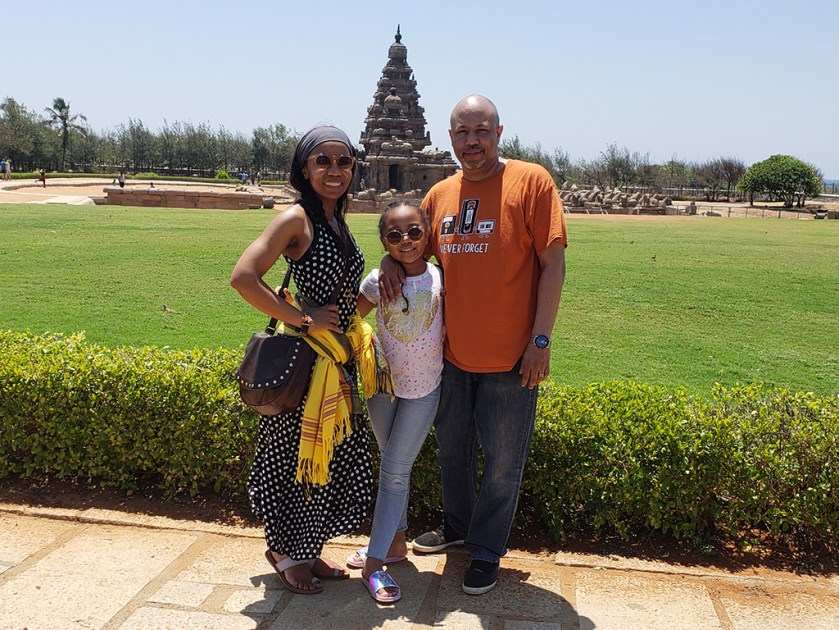
It. Was. Hot.
When I first mentioned to my people in India that we were coming in April, expecting them to sound excited, the first thing they all said was, “why?”
It wasn’t a why are we coming to visit. It was a why are we coming in April. This is when the temperatures start climbing and it can get unbearable. Had me trying to convince Nduku to change our itinerary to South America or Siberia. But we stuck to the plan and yes, it was hot.
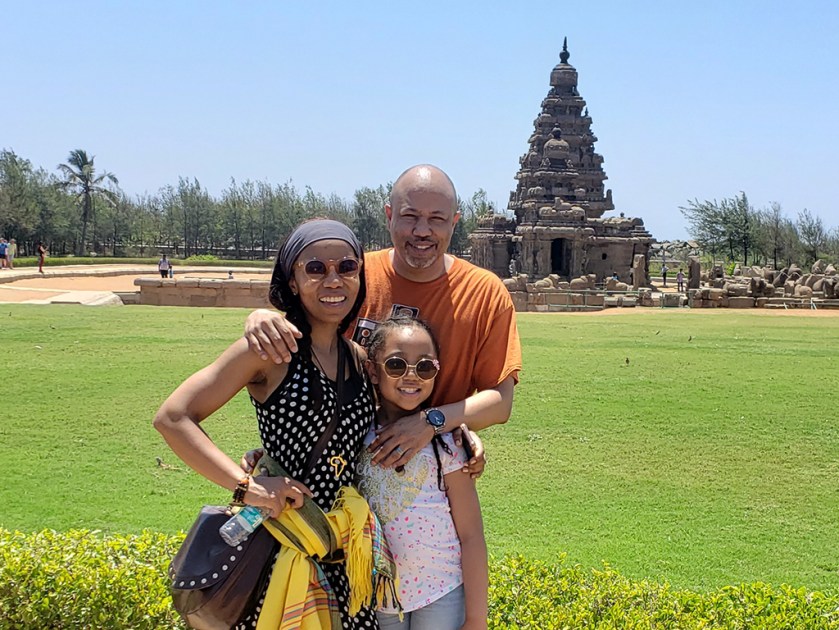
But we braved the heat to check out Shore Temple and all the other landmarks in Mahabalipuram.
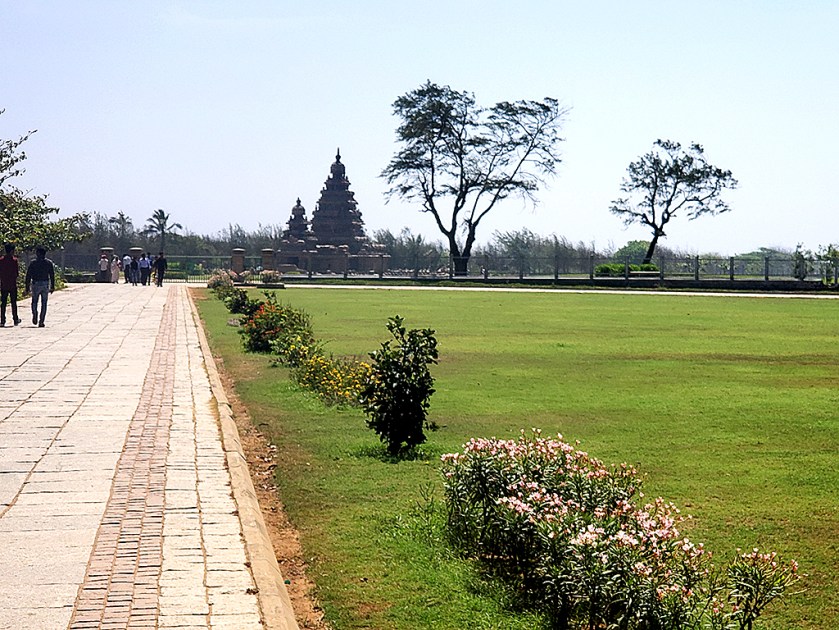
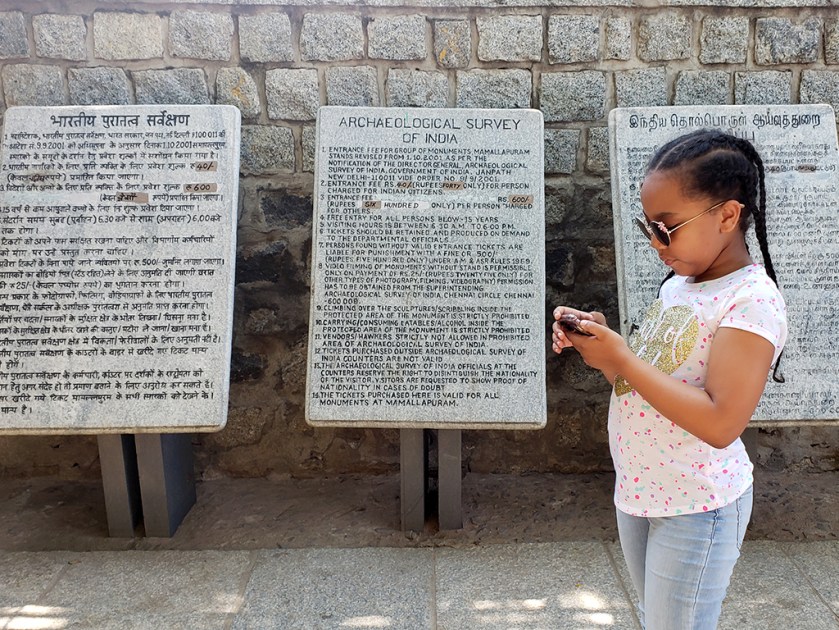
With our driver in tow and a hired guide, we headed out to the Shore Temple. Having a guide is great because they tell the history that you’d never know unless you were on Wikipedia the entire time.
Apparently, when the tsunami hit in 2004, the receding waters exposed an entire network beneath the ground they didn’t know was there. And there were more temples out in the Bay of Bengal that are submerged. The thought that there could be even more ancient sites buried beneath the ground is pretty fascinating.
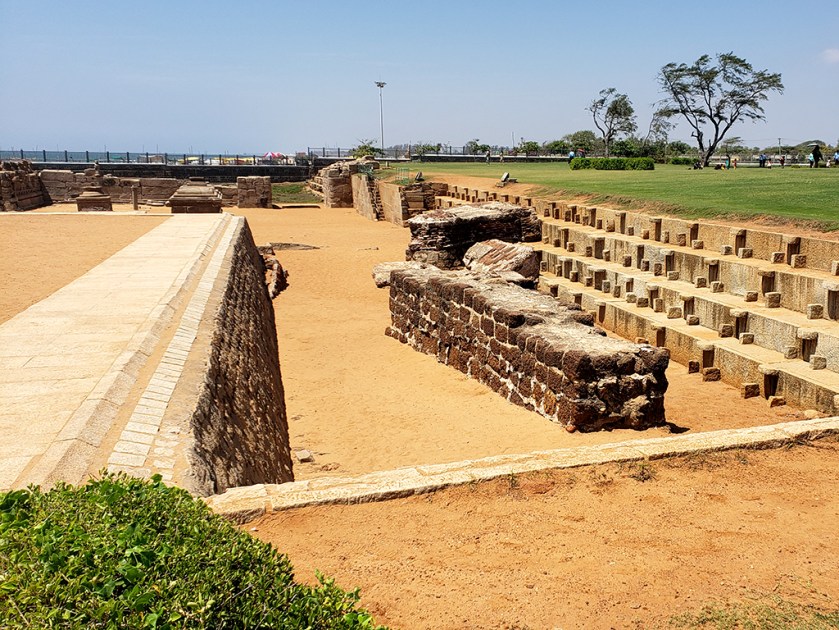
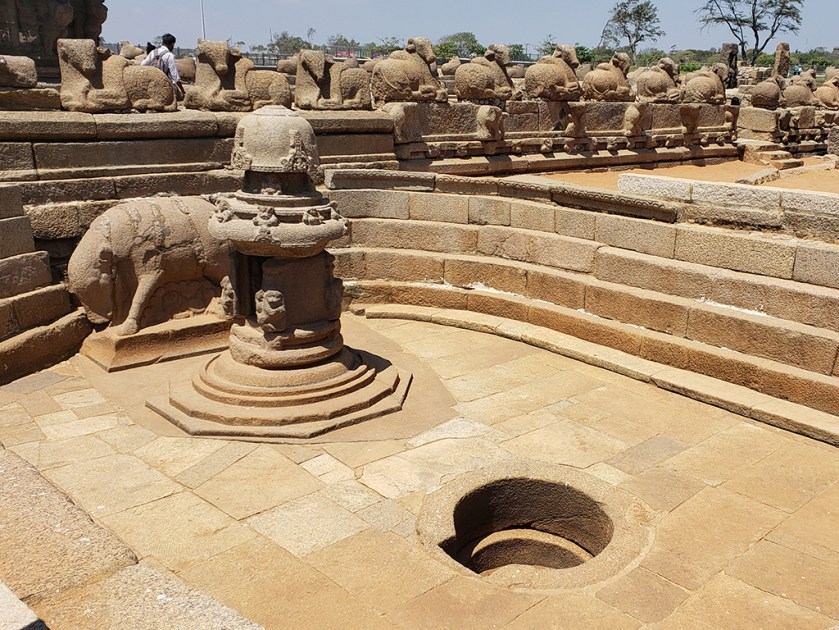
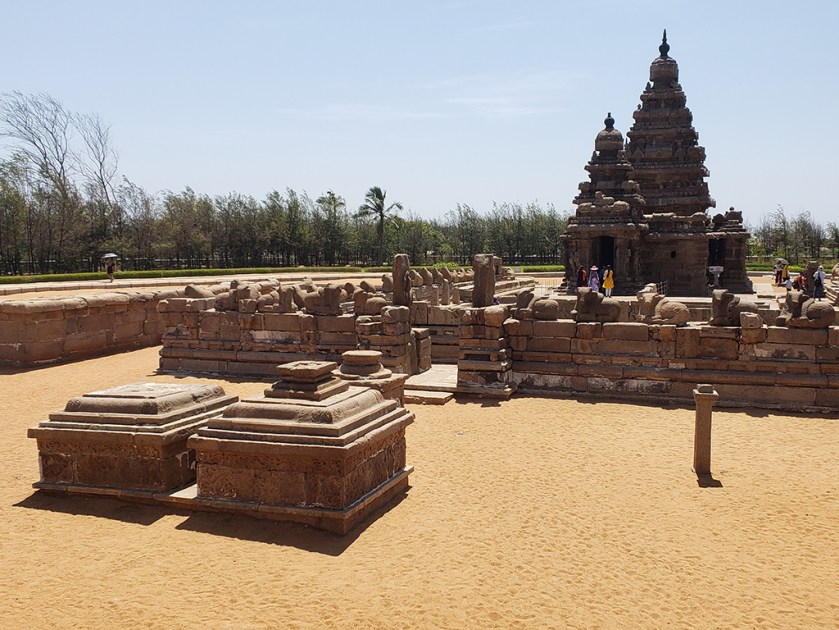
This structural temple complex was the culmination of the architectural creations that were initiated by the King Narasimhavarman II in mid 7th century starting with the Cave temples and the monolithic Rathas. Even though the architectural creation of sculpturing cut-in and cut-out structures continued during subsequent periods, as seen in the Atiranachanda cave, the Pidari rathas and the Tiger cave, the main credit for the architectural elegance of the Shore Temple complex in the category of structural temples goes to the King Rajasimha (700–28 AD), also known as Narasimhavarman II, of the Pallava Dynasty. It is now inferred that this temple complex was the last in a series of temples that seemed to exist in the submerged coastline; this is supported by the appearance of an outline of its sister temples off the coast during the Tsunami of 2004 which struck this coastline.
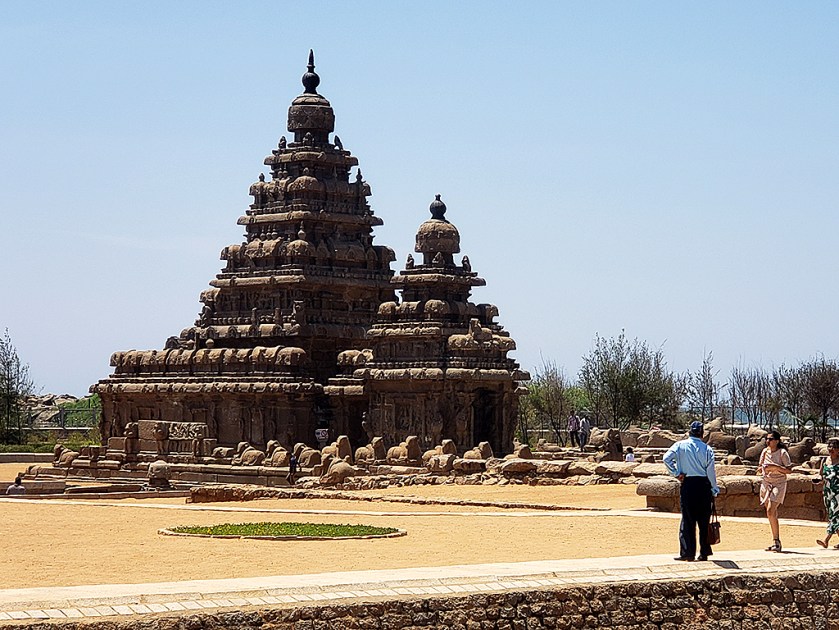
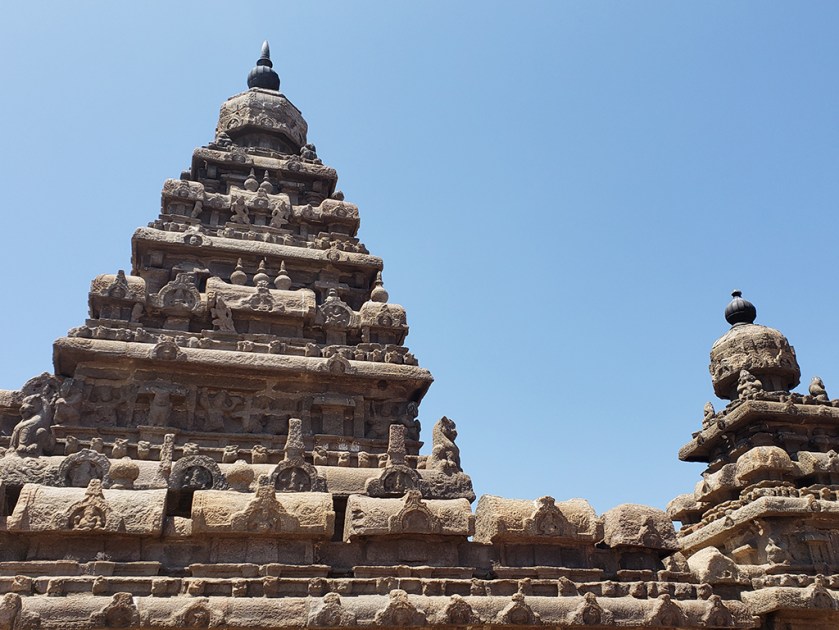
It’s not as big as I thought it would be. But the cuts and sculpting and intricacies were special. I mean, who takes the time to make such elaborate structures? To think that even afte rthe 2004 tsunami and over a thousand years of weathering the storms, it’s still standing.
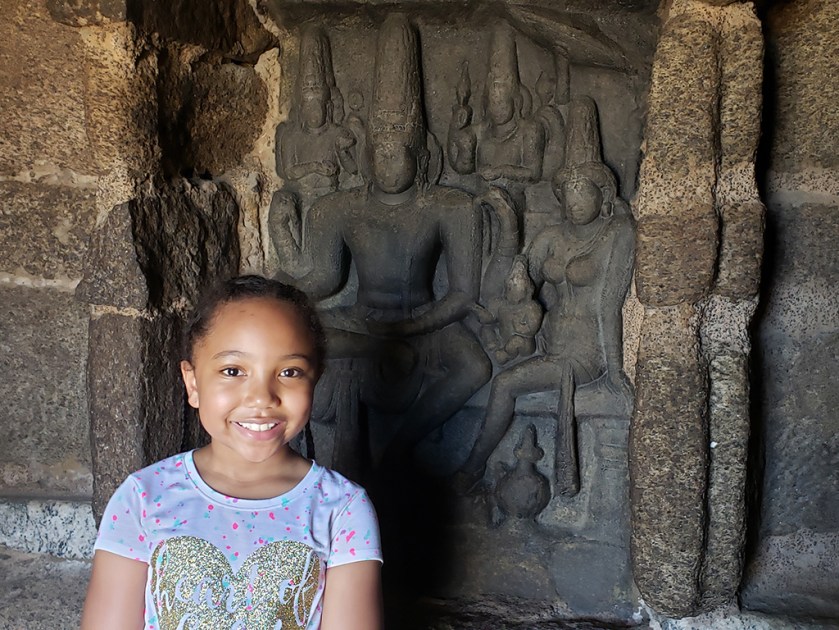
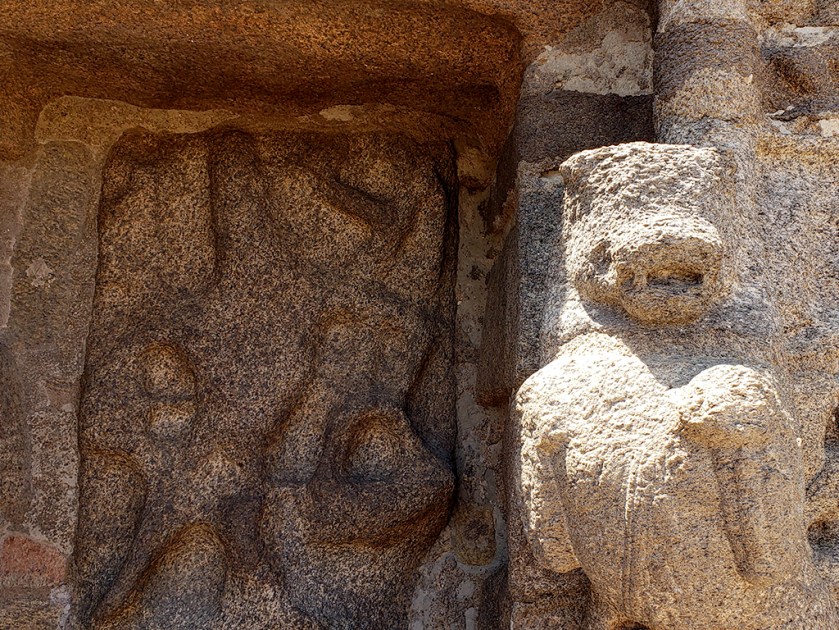
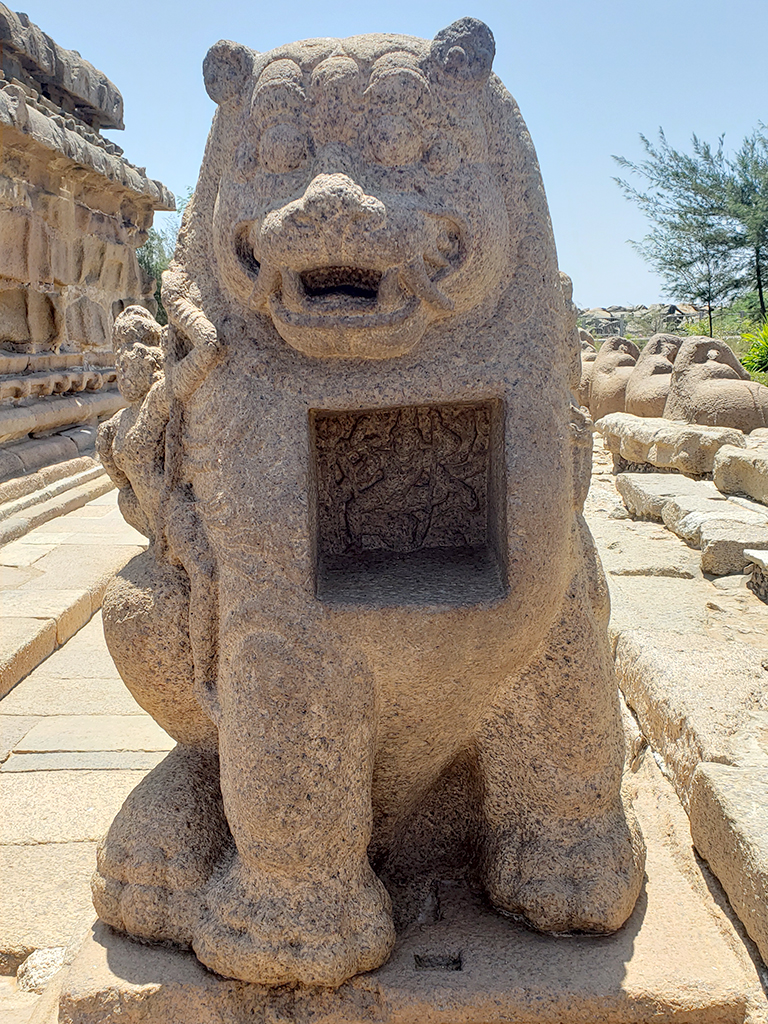
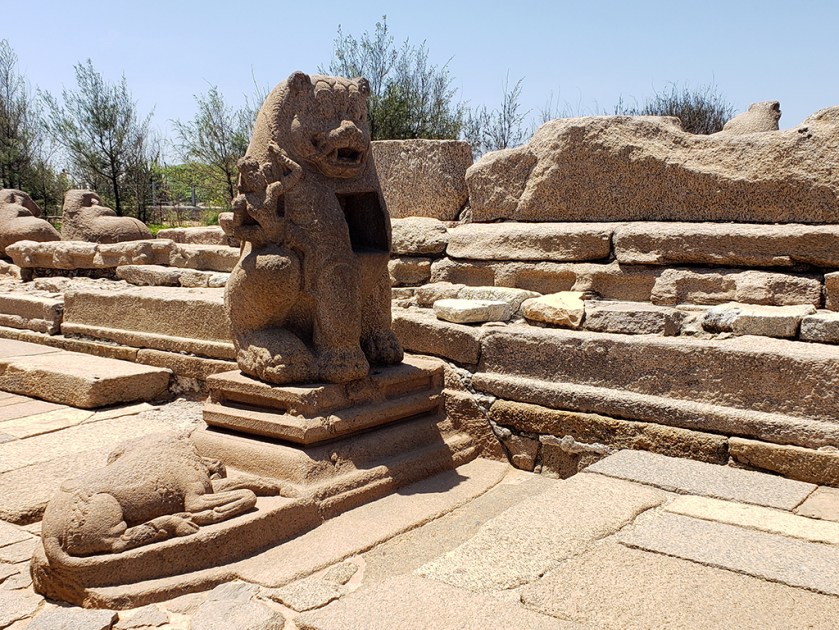
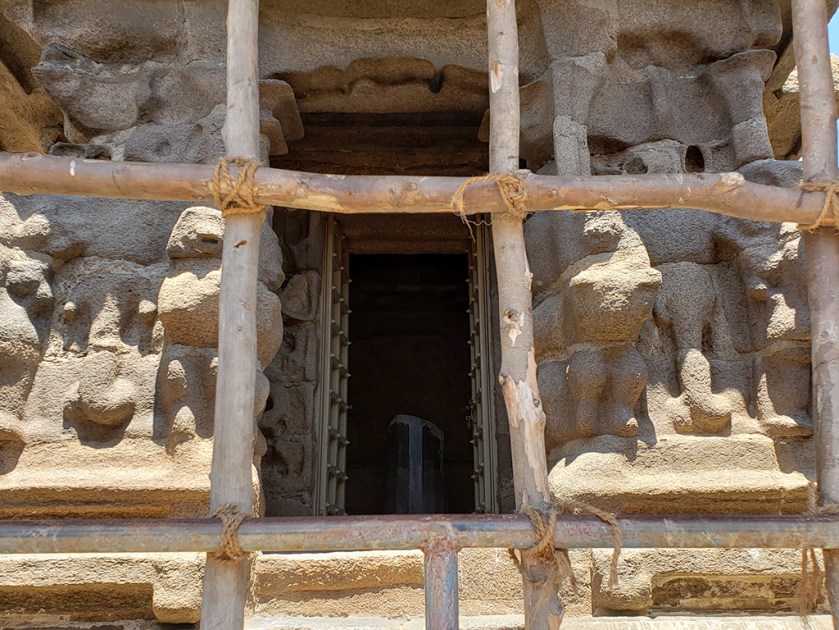
I wanted to go inside, but the tsunami did damage the base requiring some work. Gives me an excuse to have to come back another time.
Shore Temple is only one of many sites to visit in the area. Next we moved on to the Five Rathas.
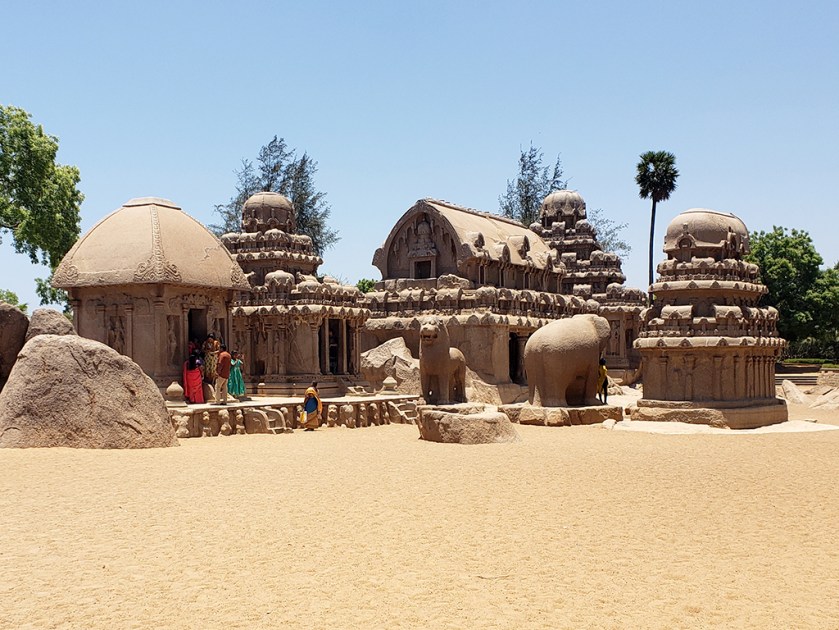
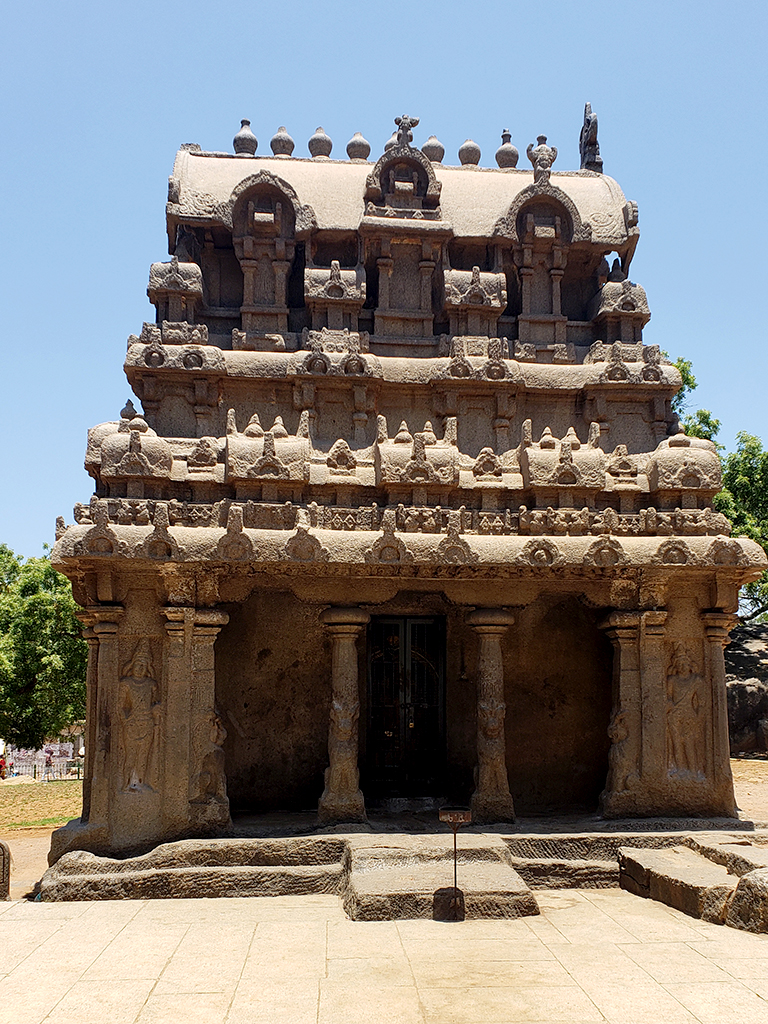
Pancha Rathas (also known as Five Rathas or Pandava Rathas) is a monument complex at Mahabalipuram, on the Coromandel Coast of the Bay of Bengal, in the Kancheepuram district of the state of Tamil Nadu, India. Each of the five monuments in the Pancha Rathas complex resembles a chariot (ratha), and each is carved over a single, long stone or monolith, of granite which slopes in north-south direction with a slight incline. Though sometimes mistakenly referred to as temples, the structures were never consecrated because they were never completed following the death of Narasimhavarman I. The structures are named after the Pancha Pandavas and their common wife Draupadi, of epic Mahabharata fame. In order of their size, they include the Dharmaraja Ratha, Bhima Ratha, Arjuna Ratha, Nakula Sahadeva Ratha, and Draupadi Ratha.
What makes these structures impressive is that they used to big one huge giant slab of stone and a bunch of people chipped away until these structures were all that was left. The precision had to be, well, precise. Chip away too much and there’s no way to get it back.
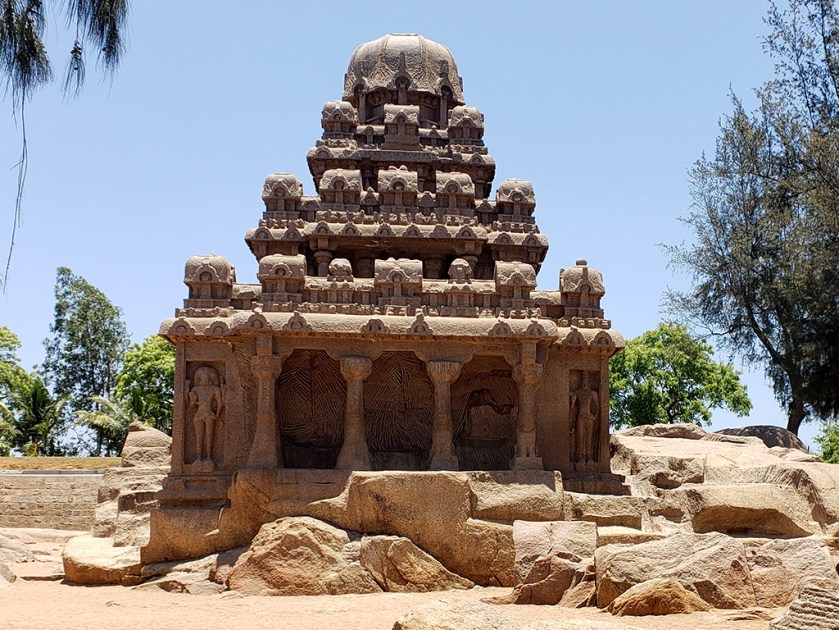
Dharmaraja Ratha is the most prominent architecturally of the five rathas and also the tallest and largest. There are many sculptures on the corners of the sanctum, which depict Shiva; Harihara, Brahma-Sasta, Skanda, Brahma, Ardhanarisvara (half Shiva half Parvati) and Krishna are depicted alongside an inscribed portrait of a king, indicated to be Narasimhavarman I, who commissioned the temple. The shafts of the pillars are supported by seated lions. The second floor contains rich imagery, with further depictions of Shiva as Gangadara and Natesa, and Vishnu resting on Garuda and Kaliya Mardhana.
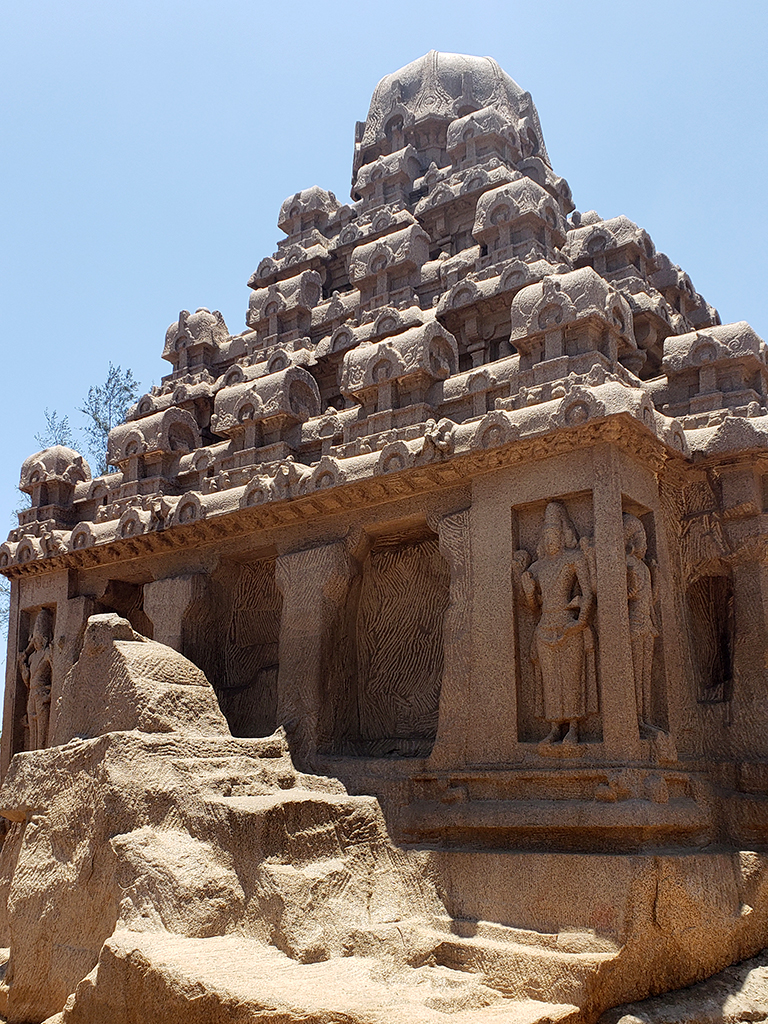
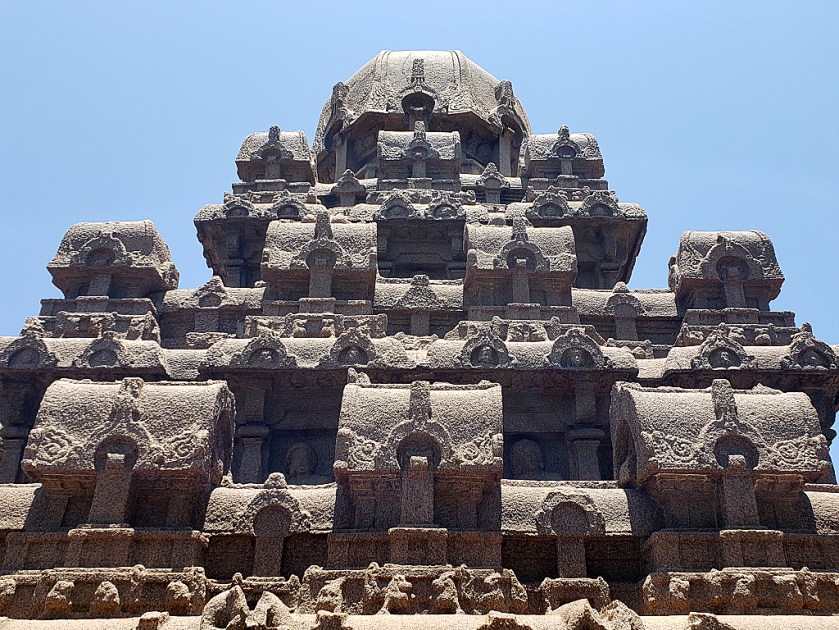
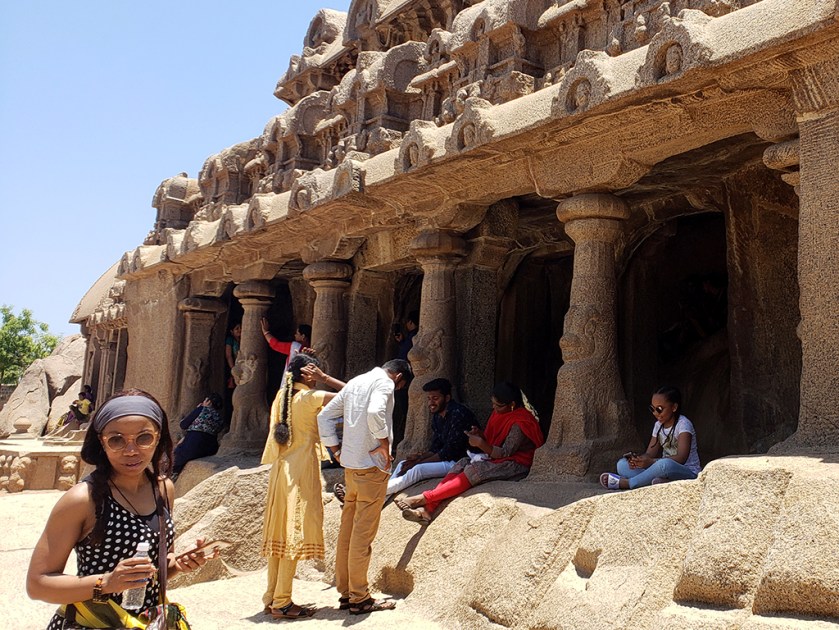
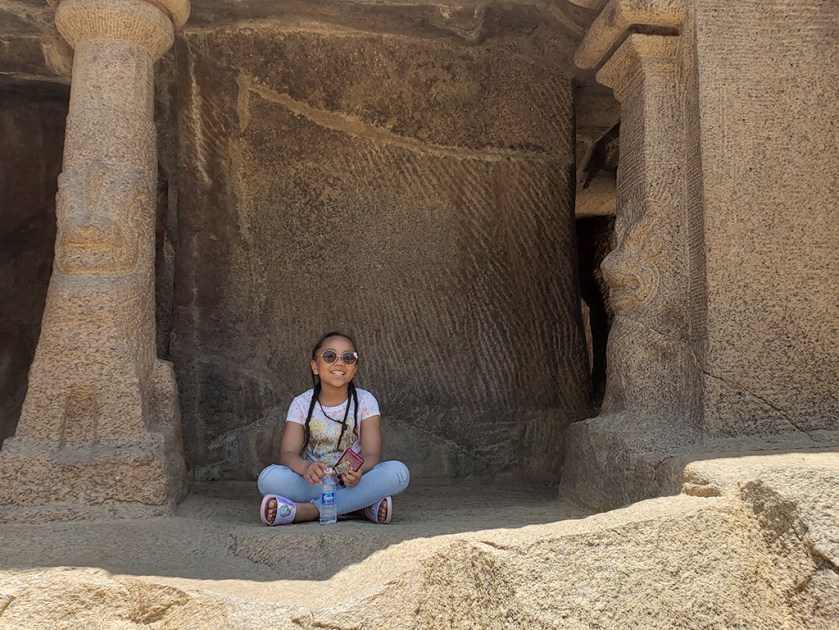
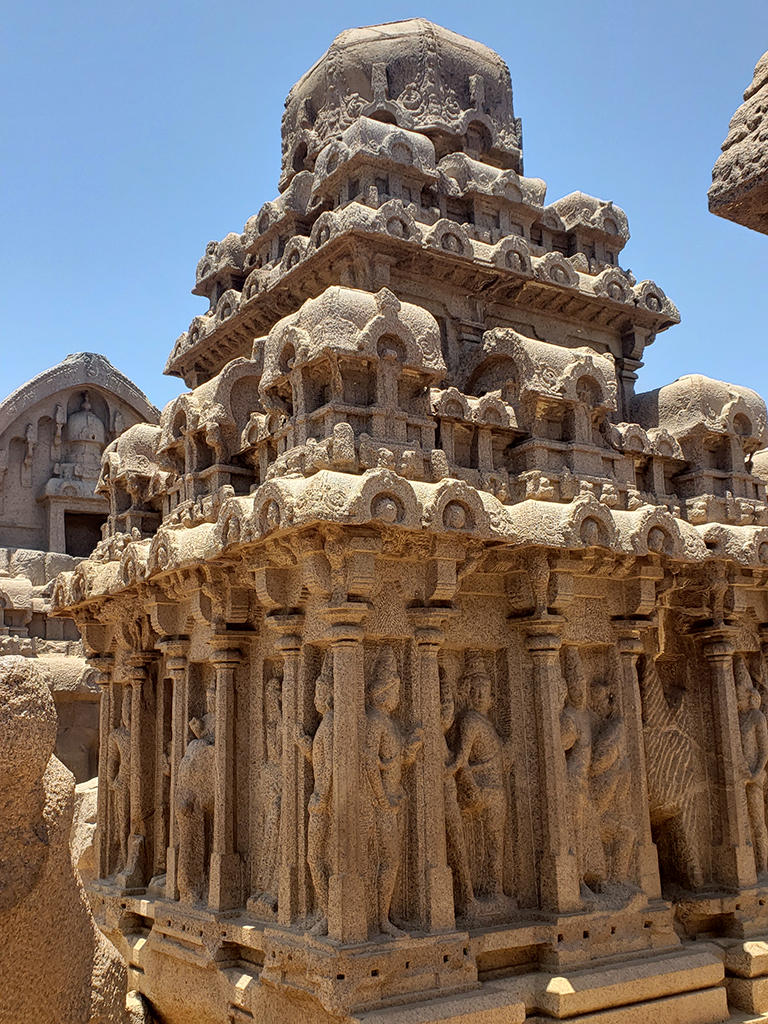
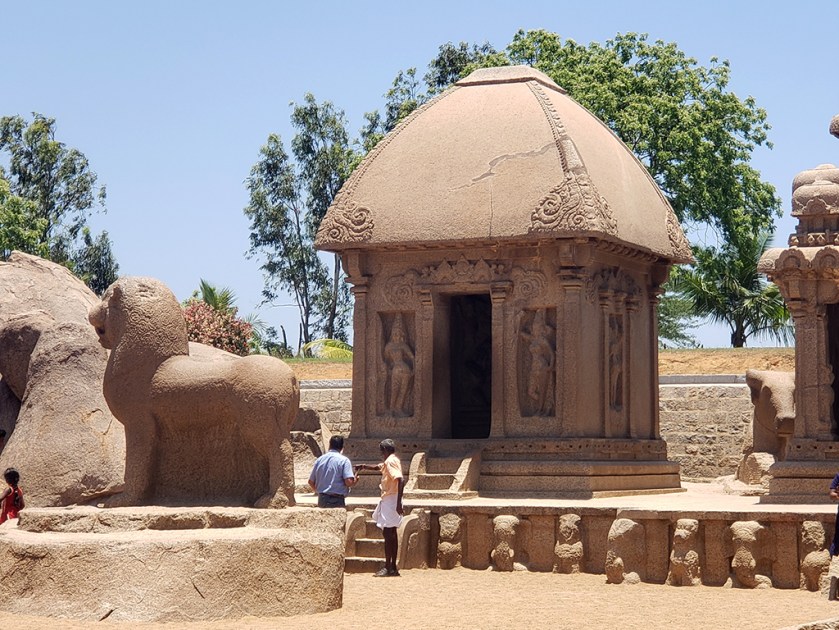
This ratha is similar in form to the Dharmaraja Ratha except that it has one less tier at the top, and has an octagonal dome with a stone lion carved in the front yard. The walls of the ratha are carved into panels with fourteen sculptures. Four of these are dvarapalas, one Vishnu, a rishi (sage) with a student, a Kartikeya (Murugan) which could alternatively be Indra, one Shiva with Nandi, and the rest are human beings shown in different stages of their life including couples.
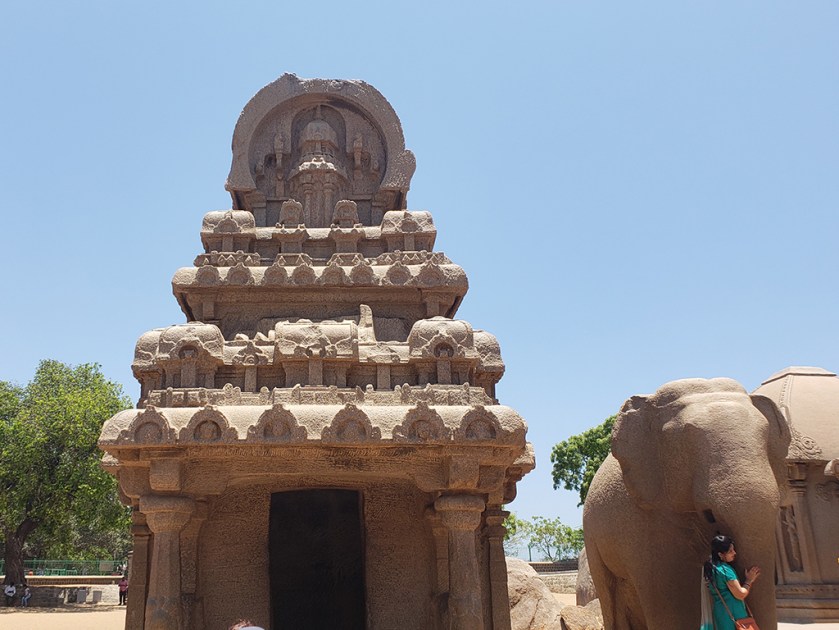
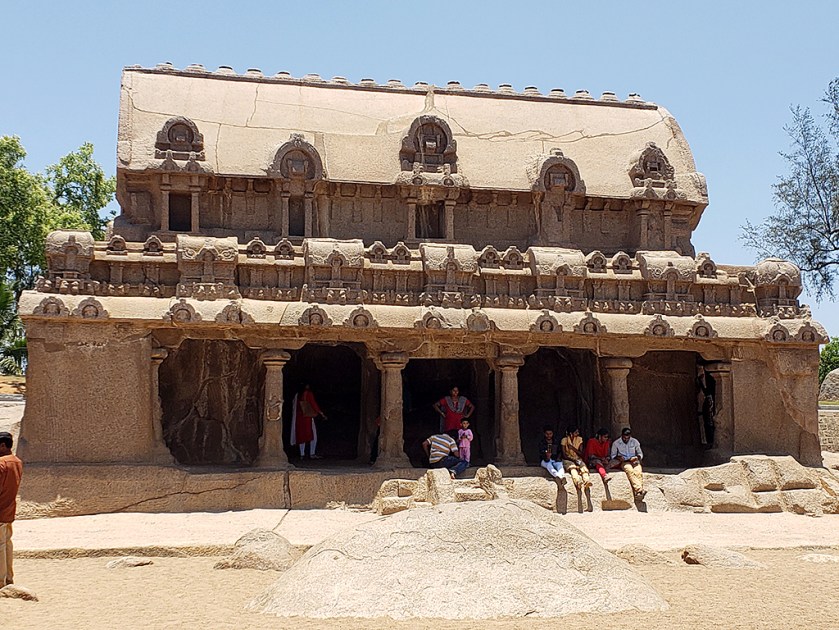
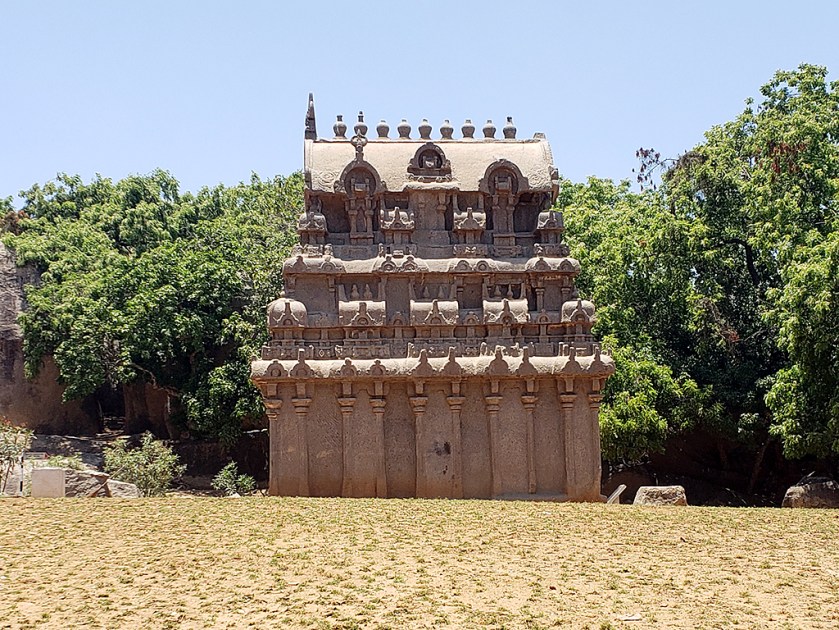
The carvings were sculpted from the top to the bottom of rathas. The sculpture in the form of reliefs on the walls inside the Nakula Sahadeva ratha is of Ardhanariswara. It is also mentioned that this ratha is dedicated to Candesa, and the elephant sculpture placed outside the ratha is considered an unusual location, as a Vahana or a mount of god, while it is normally placed in front of the ratha).
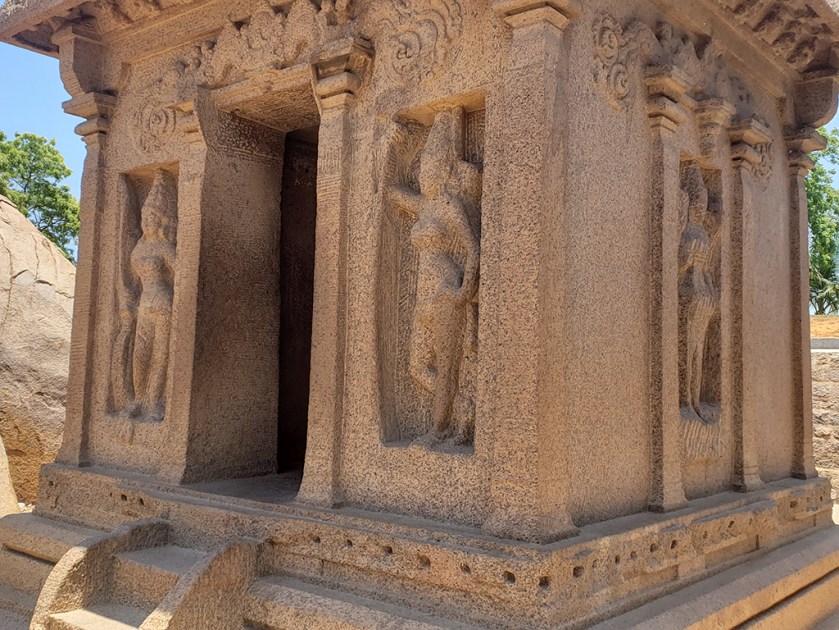
Numerous images of Durga are seen represented in the temple, notably on the sanctum and also on the exterior surface of the east facing wall. The shalabhanjikas or two female dwarapalakas guard the doorway, which are also in the form of the Goddess. The temple is stated to generate “primal energy” in consonance with the characteristics of deity of Durga; the dwarapalika on the left has a bow in her hand and that on the right has a sword.
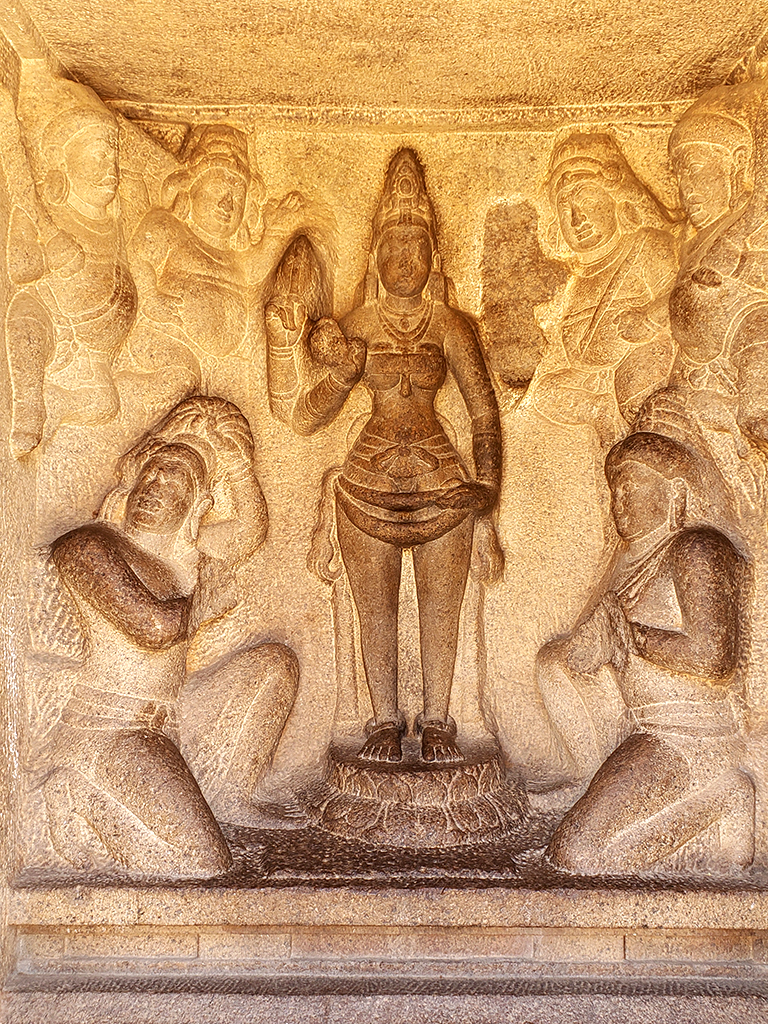
The sanctum depicts Durga on the back wall standing on a lotus, in what is termed as “sambhaga” (standing) posture with four hands, with the upper hands carrying a shankha and a chakra and one lower hand is in an abhaya mudra (posture of a blessing) and the other hand is on hip. The ornament worn is a breast-band without any halter straps. She is surrounded by devotees with a devotee on her left about to decapitate himself as an offering (in another version it is inferred as a flower offering by the devotee), and another devotee (with tied tresses exposing his neck to be cut) on her right mutilating his body parts, also in offering; this was a Hindu rite associated with the Kapalikas. This type of offering to a goddess, though ghastly, is seen in many Durga temples; it is related to the myth of her role as Mahisasuramardini (slayer of demon Mahishasura). Durga images in niches have depictions of the goddess standing on a buffalo head representing the Mahishasura.
Next on the tour was Krishna Mandapa.
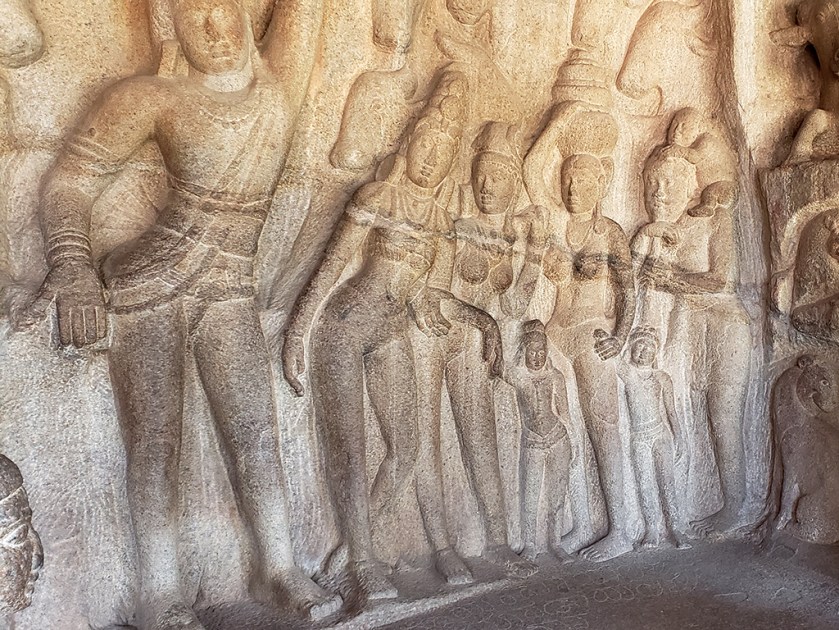
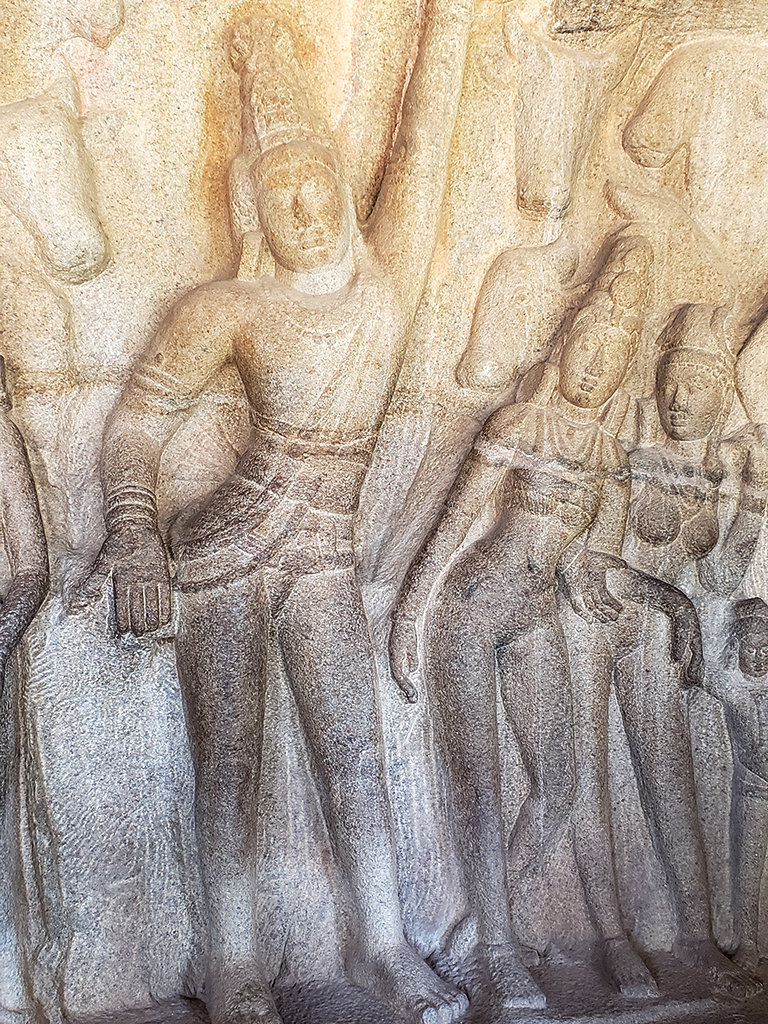
One prominent relief depicts Krishna lifting the Govardhana Hill on the finger of his left hand to save the people from a deluge caused by rains showered by Indra. People with their cattle are shown taking shelter under the mountain. The story related to this depiction is linked to Indra. Indra was annoyed with the people of the village (now Mathura) as they had discontinued celebration of a festival in his honour. He created a huge storm with heavy rainshowers, threatening the life of the villagers. Krishna, who was from the same village, lifted the Govardhana Hill (near Mathura), creating an umbrella of protection and saving the village, its people, and the cowherds. In this relief, Krishna is flanked by three females to his right; one of them is inferred as Radha, his childhood lover, as she is shown wearing a kirita makuta crown, a breast band, and many ornaments. On his right stand two figures, one male and one female. In addition, there are several other images in the panel of animals and village folk.
In another relief, Krishna is shown in a joyous mood with his gopis (milkmaids), a reflection of his double role as a divine being.
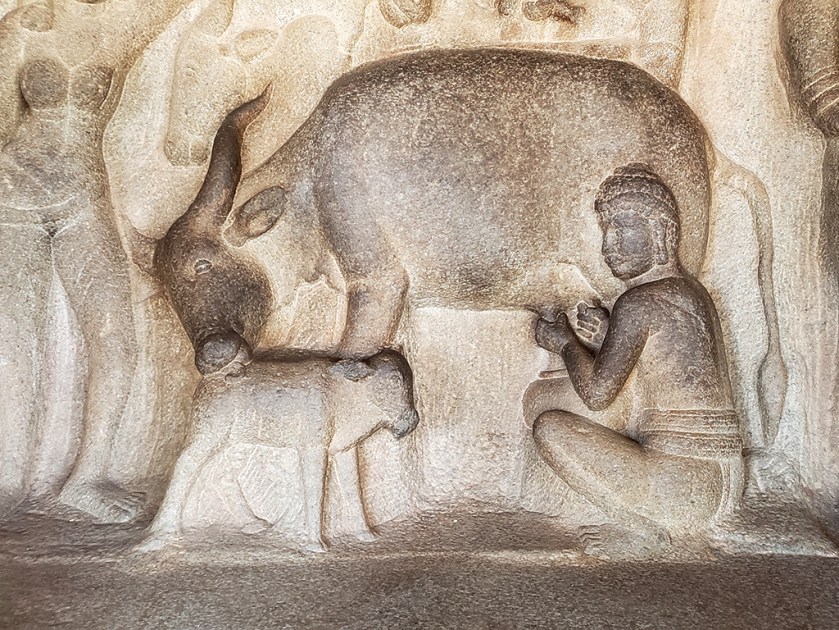
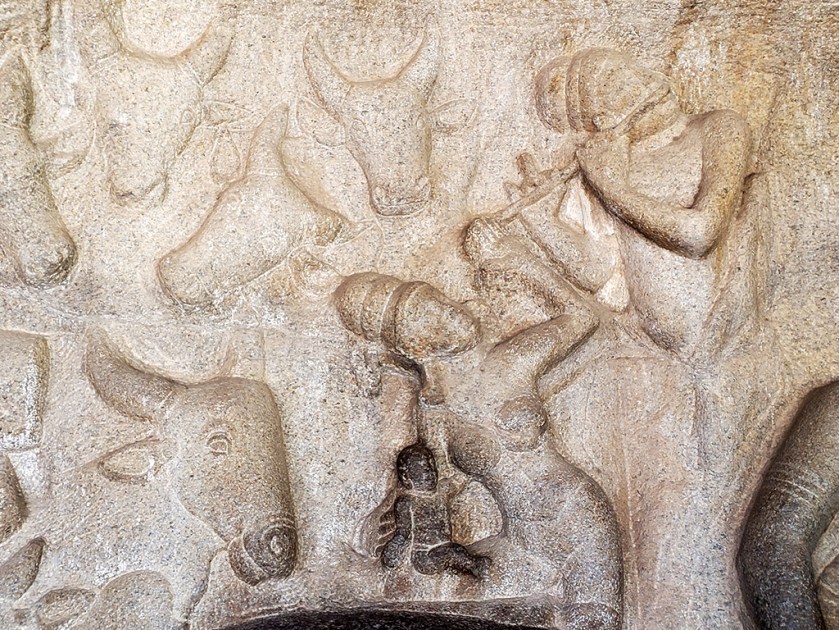
Other reliefs carved on the walls of the cave depict: an elderly person carrying a child on his shoulders, a village scene of cowherds milking a cow with the cow licking the calf; the gopis with water pots on their heads amidst a cowherd playing a flute; a woodcutter walking with an axe and a lady carrying a milk pot and a rolled mat or bundle of grass; and a child hugging her mother. Krishna’s fresco also shows him playing a flute in the fields. The panel further depicts a standing bull, which is perfectly carved by the Pallava artists. In particular, the carvings in the Krishna cave are reported to be very realistic reinterpretations of themes from the Hindu epics.
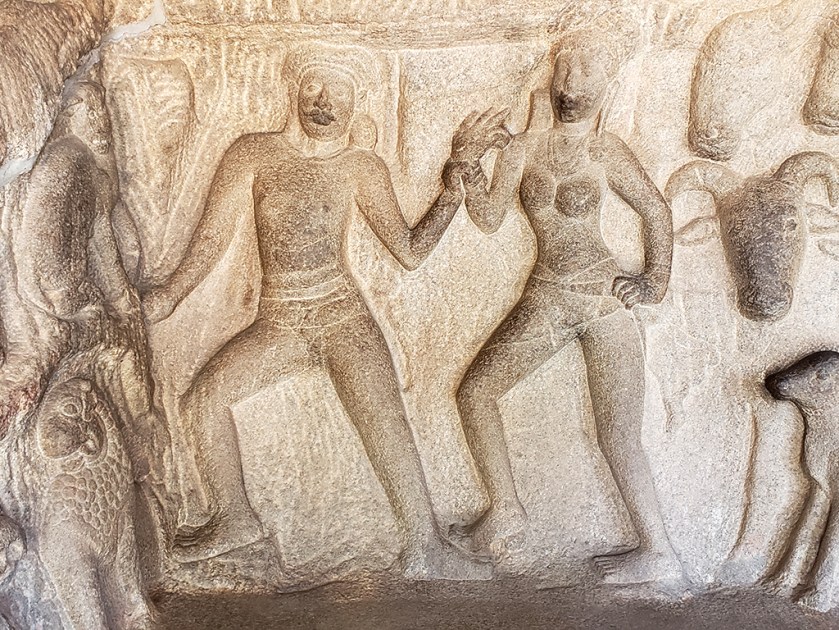
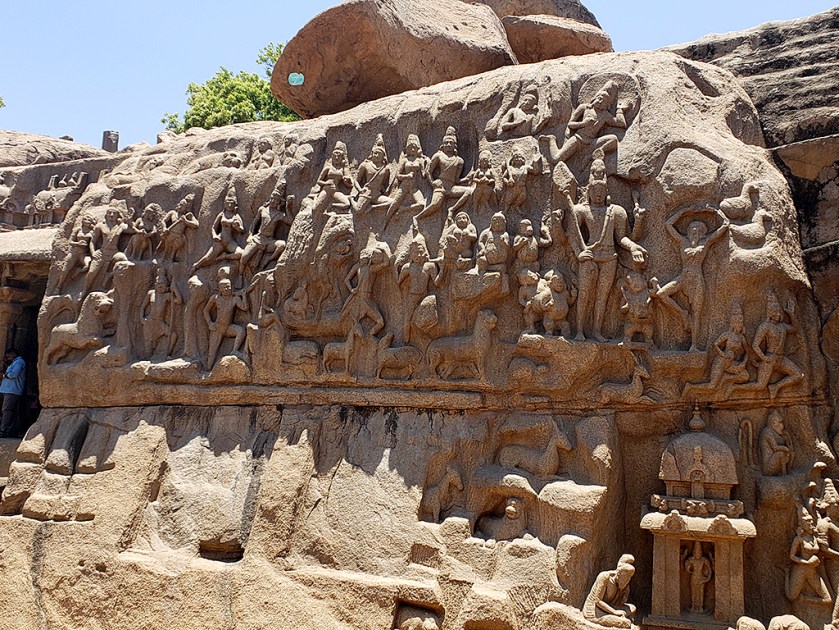
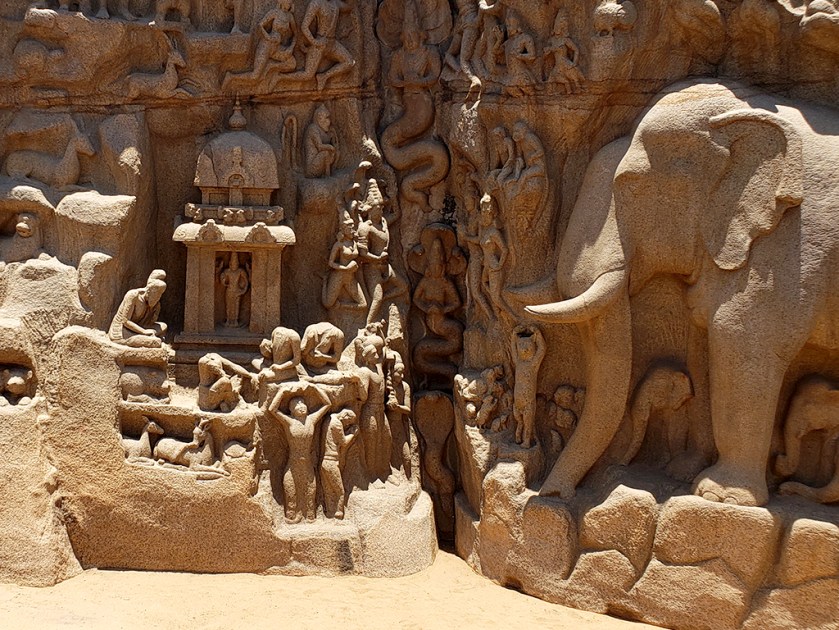
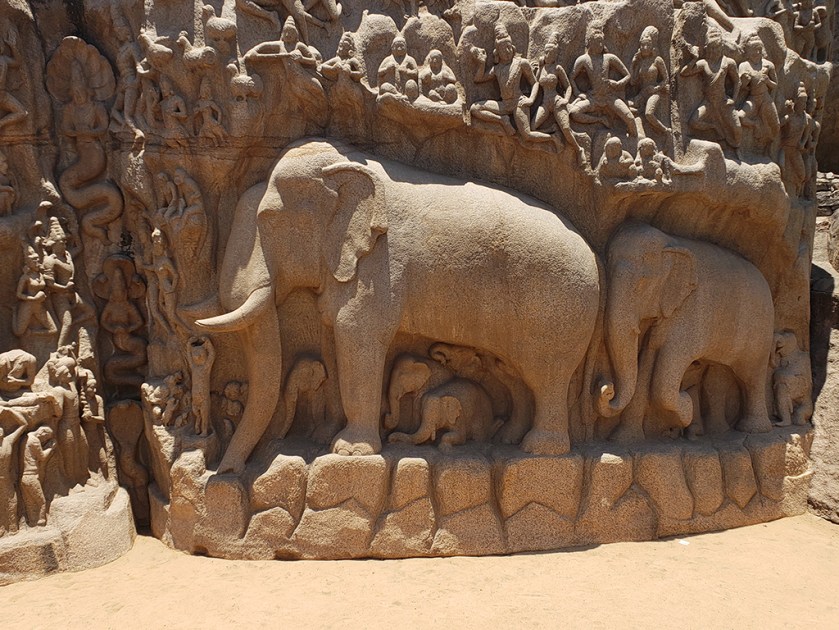
In one interpretation, a figure in the relief who is standing on one leg is said to be Arjuna performing an austerity Tapas to receive a boon from Shiva as an aid in fighting the Mahabharata war. The story of the penance is narrated in the epic Mahabharata under the subtitle the Kiratarjuniya. The boon, which Arjuna is said to have received, was called Pasupata, Shiva’s most powerful weapon. According to the myth narrated on this event, asuras (demons) sent a boar to kill Arjuna. Then Shiva appeared on the scene to protect Arjuna assuming the form of kirata (hunter). Both Arjuna and Shiva shot arrows at the boar and the boar was killed; both claimed credit for killing it and a fight ensued between the two in which Shiva won. He then revealed his true self to Arjuna and blessed him and gave him the weapon for which Arjuna is shown performing the penance.
The tour was wrapping up. At this point the sun had beaten me down. This is Nduku’s type of weather so she was fine. I couldn’t tell with Najwa, but kids have to tendency to not know when they’re overheating until they’ve overheated.
The last two sites were the Ganesha Temple and Krishna’s Butter Ball.
The interesting thing about Krishna’s Butter Ball is that it’s not something that’s coming out the ground, a carving or anything. It’s literally a huge rock sitting on the ground. Only, the ground is slanted, the rock is heavy, but for whatever reason, it has never rolled down the slope.
Krishna’s Butterball is a gigantic granite boulder resting on a short incline in the historical town of Mamallapuram. The boulder is approximately 6 meters high and 5 meters wide and weighs around 250 tons. It stands on an approximately 4 feet base on a slope, and is said to have been at the same place for 1200 years. In 1908, then-governor of the city Arthur Havelock made an attempt to use seven elephants to move the boulder from its position due to safety concerns, but with no success.
It is said that Pallava king Narasimhavarman also made a failed attempt to move the boulder. The original name, Vaan Irai Kal translates from Tamil as “Stone of Sky God.” According to Hindu mythology, lord Krishna often stole butter from his mother’s butter handi; this may have led to the namesake of the boulder.
Imagine. There’s this 250 ton rock balanced on a slope. It’s been there for over a thousand years. And no matter how much anyone has pushed it, even with seven elephants, it hasn’t budged. And when Najwa passed on the chance to see if she could move it, saying she was ready to go, that’s when I knew she was probably burning up in the sun and just ready for some shade.
My friend Nithish recommended a place called Moonrakers if we were going to eat in Mahabalipuram. So we did.
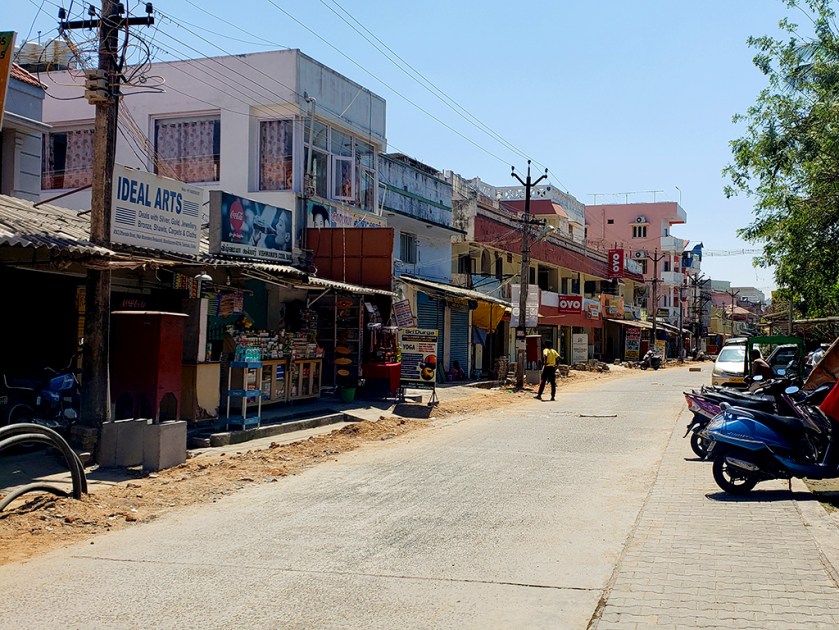
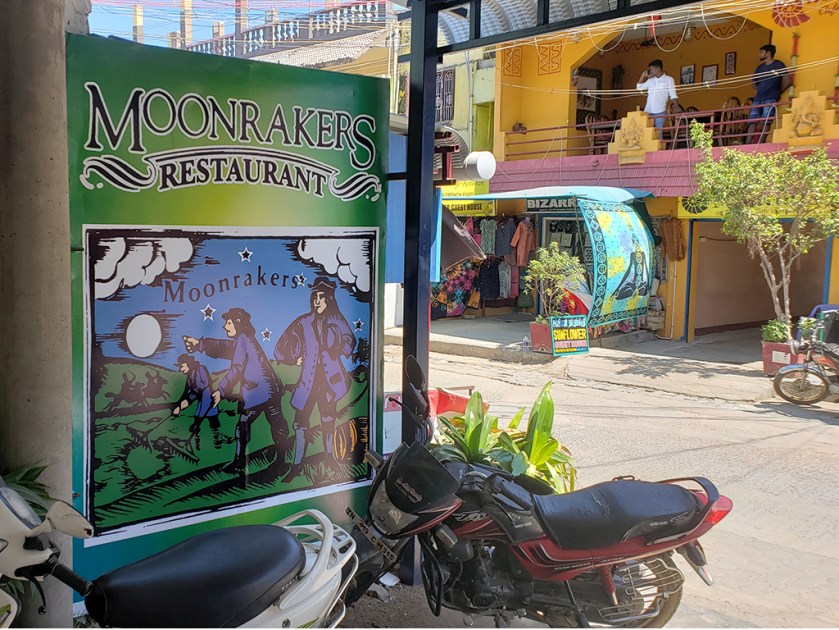
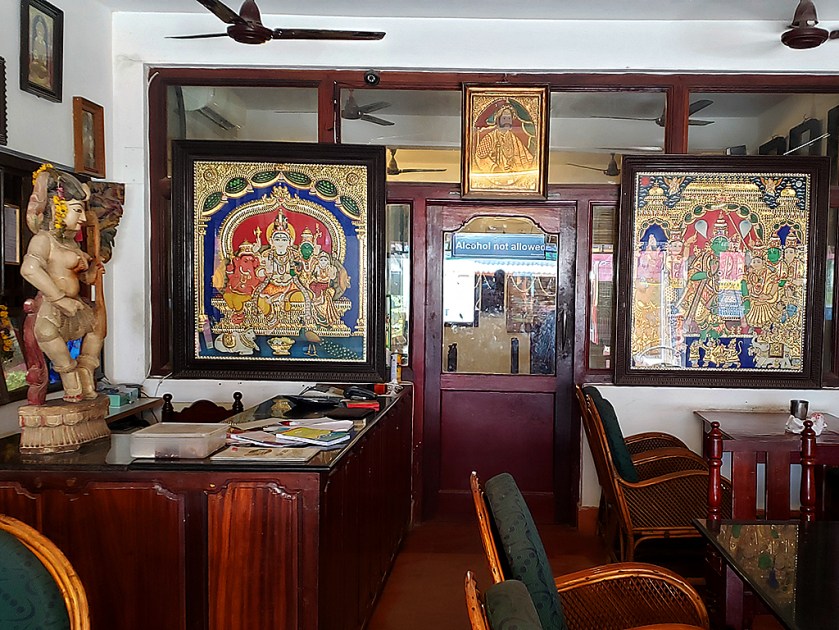
First of all, the main dining area is not enclosed. I’m so glad they had an air conditioned sitting area. Second of all, when they say ginger tea, they meant tea with ginger dropped in it. It was good though.
But most importantly, the food there was the absolute best we had on the entire trip! I got this dish called tava chicken. Never heard of tava and they couldn’t explain it to me. But it was delicious! Too bad I couldn’t find tava chicken at other restaurants we visited throughout our trip.
Afterwards we headed back to the hotel. It was a good day.

 contrails